C++26 adds a `<debugging>` header with `std::breakpoint()`, `std::is_debugger_present()` and `std::breakpoint_if_debugging()` for setting breakpoints and checking whether a debugger is attached. Sandor Dargo explains the functions standardized by proposals P2546R5 and P2810R4, credited to Rene Ferdinand Rivera Morell, and notes that debugger detection can be replaced by platform-specific implementations.
Researchers at pwn.ai say they found CVE-2026-99999, a Linux networking flaw in which guest-controlled checksum metadata could alter an already-validated IPv4 header, enabling a 32-byte host-memory disclosure and, in their own KVM lab, a guest-to-host escape. Linux merged upstream fix 6785011f8b16 in October 2026, adding checks before checksum completion in five IPv4 paths.
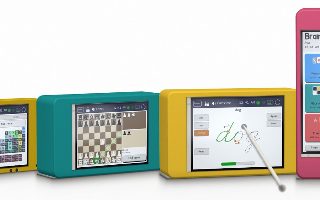
Ankush Pandit’s Braino! turns a Cheap Yellow Display into a low-cost children’s learning device, with 40 selectable games and optional Bluetooth multiplayer. The GPLv3 software is installed through a browser-based flasher and has no ads, user accounts, or cloud connectivity.
K. Sosnierz shows how to turn a book such as *Moby-Dick* into an animated 88×31 GIF using ImageMagick and the tiny TomThumb font. The author’s full-book GIF is 4.2 MB and runs for more than 19 hours, with shell commands for wrapping the text and cropping the animation.
Phoronix’s Michael Larabel benchmarked LPDDR5 memory at 5467, 6400 and 7467 MT/s on a Star Labs StarFighter Ultra Linux laptop to compare performance and power use. The laptop’s BIOS allows memory speed changes, and Star Labs defaults its rated 7467 MT/s memory to 6400 MT/s for a balance of power and performance.
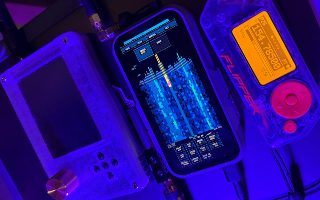
Samson1te has uncovered software-defined radio functionality in Semtech’s LR2021 LoRa chip, which supports 2.4 GHz and 150–960 MHz radios. The 16-bit SDR can transmit and receive; its early demo handles P25 digital voice, with documentation available.
Developer Cobanov’s PS5LM is a homebrew app for jailbroken PS5 consoles that runs GGUF models with llama.cpp on the console’s GPU and serves them over a local network through OpenAI- and Anthropic-compatible APIs. On a PS5 Slim, it reports speeds of 55 tokens per second for a 9B model and about 20 tokens per second for a 27B model; it also supports decision models and image input.
Lay Sheth released siltop, a Rust system monitor for Apple Silicon Macs, designed to show CPU, GPU, memory, power, clocks, temperatures and per-process energy without requiring sudo. The project says it supports M1–M5 chips and adds process management, JSON and Prometheus output, alerts and session recording; it is not intended for Intel Macs or Linux.
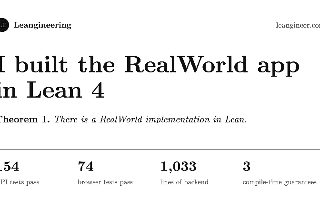
The author built a Medium-style RealWorld app entirely in Lean 4, including its Postgres-backed server and interactive website, and says it passes the project’s API and browser test suites. The backend is 1,033 lines; the post describes Lean-checked guarantees for route types, slug validity and HTML escaping, while noting the app was not derived from a formal specification and would need careful review before serving users.
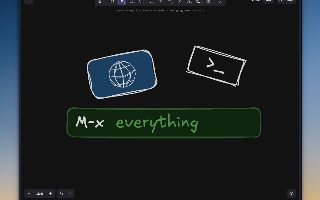
Uncle Xnet released Portal, an open-source, macOS-only project that embeds native WKWebView and Ghostty terminal views in Emacs panes. It also serves offline web apps such as Excalidraw and renders Markdown and HTML previews inside Emacs; it requires graphical Emacs with dynamic-module support, and module failures can crash Emacs.
Step Chow Fun’s Mull is a plain-text wiki tool that stores linked pages in a single `.mull` file and offers a VS Code and Cursor extension with completions, previews, diagnostics, formatting, and refactoring. It also checks that wiki pages and linked files are reachable, supports synchronized page portals and formatting scripts, and can run from the command line.
Cloudflare has open-sourced Void, a Vite-based toolchain for building and deploying full-stack JavaScript apps on Cloudflare. The package combines an SDK for routing and typed data access, a CLI that provisions resources and deploys apps, and an optional shared platform that lets organizations manage users, access, and deployment limits.
Haxy, a new git forge from developer Alex, is in preview and offers a web interface plus a terminal interface over SSH. It stores issues, pull requests and discussions in a special Git branch so users can edit project metadata locally and sync it between instances; unlike Radicle, Haxy is federated rather than peer-to-peer.
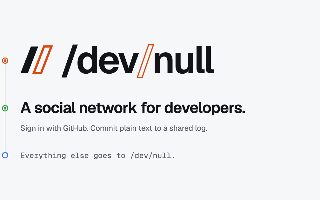
/dev/null is a social network for developers where users sign in with GitHub, follow other coders and post plain text to a shared log. The site says it has no likes, reposts or algorithm, and invites visitors to watch it being built live.
Anthropic researchers say Claude traced the seeds for most NIST ECDSA curves to the lrand48 pseudorandom generator, initialized with Unix timestamps in 1997–98; it also linked six early curves’ base points to software by Arjen Lenstra. The team says the findings do not reveal a cryptographic weakness and make deliberate backdoors less plausible, though the B-163 seed and several base points remain unexplained.
Fresnel is a separate widget toolkit for Free Pascal and Lazarus applications, using CSS for control styling and layout while keeping program logic in Object Pascal. Its developers say the same code can compile into native apps for Windows, Linux, macOS and Android, or to WebAssembly for browsers; it can also be used alongside the LCL.
Libreboot 26.10, released by project lead Leah Rowe on 15 October 2026, makes the open-source EDK2 UEFI firmware the default on nearly all supported 64-bit systems, enabling Windows 10 and 11 and other UEFI operating systems to boot. The release also adds build support for 233 Intel and AMD Chromebooks from MrChromebox, adds several other boards including the ThinkPad X280 and Dell OptiPlex 5050 SFF, and replaces the AMD Fam15h coreboot tree with a more reliable 15h.org fork.
Calif researcher Andrew Griffiths reported an OpenBSD kernel bug dating to the original BSD sources: a signed 16-bit shared-memory attachment counter could overflow, enabling a race-driven use-after-free that, combined with a separate out-of-bounds write, allowed local privilege escalation to root. Calif developed an exploit that worked with KARL, SMAP and SMEP enabled, and says the flaws were fixed in OpenBSD errata 026 and 018.
Raymond Chen says `WIN32_LEAN_AND_MEAN` was introduced around the Windows 95 transition to 32-bit Windows, so `windows.h` could omit headers and retain the minimal-inclusion approach of 16-bit Windows. On a 50 MHz 80486, he recalls it cutting about three seconds from each C file’s compile time; faster computers and precompiled headers have since made the savings negligible.
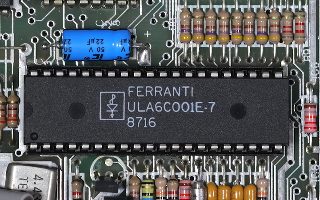
Original Ferranti design documents for the ULAs used across Clive Sinclair’s 1980s products have surfaced after being bought on eBay. The collection covers devices including the ZX81, Spectrum, ZX Printer and Microdrive; Sky, which now holds the intellectual property, permitted the documents to be shared through a catalogued online spreadsheet.
GCC has adopted a policy on using large language models in compiler development that restricts their use but still allows some applications. At the 2026 GNU Tools Cauldron, Jeff Law and Kyrill Tkachov described how they have used the tools.
Jimmy Miller explores how React Compiler works and prototypes optimizations including component inlining, list memoization, selective updates, and context and store improvements. His benchmarks show speedups for some workloads, but he stresses these are proof-of-concept results, not production-ready recommendations.
Spritely developer Jessica Tallon says the next Goblins release will add federated, end-to-end encrypted relays for OCapN, using the Noise protocol to authenticate peers and encrypt messages. Funded by NLnet, the work also includes an OCapN specification, interoperability tests and a Guix service; the relay is designed to be stateless so users can switch servers easily.
Project Combine is a Rust-based effort to reverse-engineer FPGA and CPLD device geometry, interconnects, bitstreams and timing, and publish the results as databases and documentation. Its coverage includes SiliconBlue, Xilinx and several Lattice families; geometry is complete for many targets, while full databases and testing are complete for Xilinx XC9500 and CoolRunner XPLA3 devices.
Researchers at the University of Toronto and YScope Inc. introduced CLP, a system that losslessly compresses text logs while allowing searches directly on the compressed data. Their 2021 evaluation reports compression about twice as effective as Gzip, search faster than tested alternatives, and ingestion more than 13 times faster than Elasticsearch and Splunk Enterprise; the authors say its distributed design scales to petabytes.
Simon Henniger introduces rust-djinn, a research tool that turns Rust specifications into LLM-generated implementations and uses Aeneas and Lean to verify both correctness and that the spec rules out different behaviors. In a gzip decompression benchmark, its safe Rust implementation reached 787 MiB/s, ahead of the tested alternatives, including libdeflate at 657 MiB/s; Henniger says the project is not yet ready for production.