Global news, data and analysis on solar, wind, storage, hydrogen, nuclear and the grids that connect them, from breakthroughs reaching production to adoption trends.
Wood Mackenzie’s latest levelized-cost report finds four-hour battery storage is cheaper to install than open-cycle gas turbines in all 43 markets where both were assessed. It projects storage costs in the Middle East and Africa will fall from $120/MWh in 2026 to $80/MWh by 2035, while single-axis-tracker solar is the cheapest new-build power source in 43 of 48 markets.
South Africa plans to procure 4.6 GW of battery storage and 5 GW of gas-fired power under the first allocations of its 2025 Integrated Resource Plan, which targets more than 105 GW of new generation by 2039. The government says storage will help reduce renewable-energy curtailment, while gas plants will provide dispatchable power; the first allocation does not include new wind or solar capacity.
PV magazine reports that as of mid-2026, Texas was just behind California’s 55.5 GW of solar capacity and had about half its 60.6 GWh of energy storage. More than 65% of Texas’s solar capacity and 85% of its batteries were installed since early 2023.
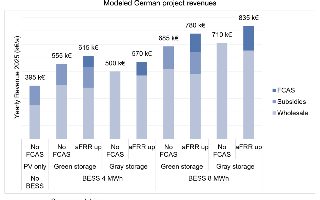
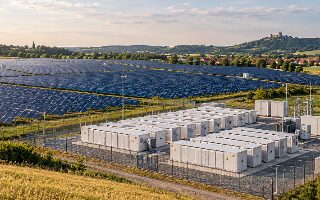
mc Advisory modeled a 4 MWp German solar project with 4 MWh or 8 MWh batteries, comparing solar-only, co-located “Green” batteries charged only by solar, and “Gray” batteries that can also charge from the grid. The analysis found storage raised annual revenues by up to €315,000 before ancillary services; adding aFRR up revenues lifted the 8 MWh Gray case to €835,000 a year, highlighting the trade-offs among battery size, EEG support and market participation.
Italy’s energy regulator ARERA raised the maximum premium for the 2029 MACSE battery-storage auction to €27,000/MWh/year, up from the €22,000 proposed in consultation, and introduced annual updates to the technology assumptions used to set auction parameters. Lawyers Germana Cassar of DLA Piper, Marcello Astolfi of Project Lex and Cristina Martorana of Legance say unresolved risks include grid access, permitting deadlines, lithium-price volatility and uncertainty over auction volumes after 2029; Terna has identified a provisional 16 GWh requirement for 2029.
Bangladesh’s Executive Committee of the National Economic Council approved a 442 MW solar plant with eight hours of battery storage beside the Rampal coal power station in Bagerhat. The Bangladesh Power Development Board will develop the project for BDT 25 billion ($200 million), with construction scheduled from September 2026 to March 2029.
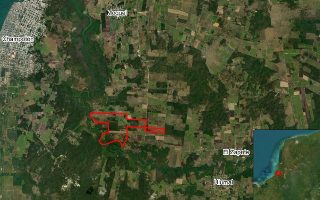
Mexico’s environment ministry conditionally approved Solarig Mexico’s PV Moquel Solar project in Champotón, including a 75 MWac solar plant and a 15 MW, 150 MWh battery system. The approval is valid for construction-related work for 24 months and operation for 30 years, but Solarig must secure forest-land and social-impact authorizations before construction.
Return has brought its 100MW/200MWh Antares battery energy storage system into commercial operation in the Netherlands. It is the largest BESS in the country to reach that stage, according to the report.
The Nantes Administrative Court of Appeal made final a 2025 Rennes court ruling that allows Renouvelables et Stockage’s battery storage project in Redon, Ille-et-Vilaine, to proceed. The ruling found the grid-connected installation compatible with agricultural activity because forage production can continue on the rest of the land, but it does not create a blanket right to build batteries on farmland.
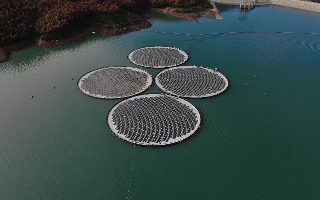
Tata Power and Norway’s Ocean Sun will test a 300 kWp membrane-based floating solar system at Tata Power’s Mulshi reservoir in Maharashtra. The pilot will compare its performance, installation, maintenance needs and costs with conventional floating solar systems to assess its suitability for wider use in India.
Antora Energy announced a 5.8GWh multi-day thermal energy storage project at Pratt Energy’s biorefinery in Pratt, Kansas. The announcement identifies the project site and capacity but gives no further details.
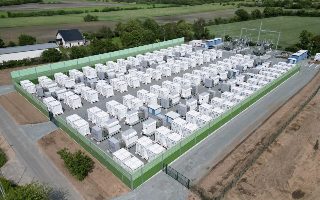
TagEnergy has inaugurated its 240 MW/480 MWh battery at Cernay-lès-Reims, making it France’s largest operational battery storage project. The facility, built with 140 Tesla Megapacks, has returned 70.5 GWh to the grid in its first four months; Banque des Territoires owns a 49% stake, with TagEnergy retaining the majority.
Cherokee County, Iowa, supervisors voted 5–0 on Aug. 26 to replace a moratorium with rules allowing battery storage projects, clearing a path for the Smith family and Nomad Infrastructure to pursue an $80 million solar-and-battery installation. Supervisor Mark Bellefy argued the project could bring $60,000–$80,000 in annual tax revenue; safety workshops and input from the fire chief helped ease colleagues’ concerns.
Chile’s Environmental Assessment Service approved Sidon Solar, a project by Sidon Solar SpA, established by Trina Solar Systems (Chile), with 158.17 MWdc of solar generation and 1,296 MWh of battery storage. The $100 million project in Biobío and Ñuble regions will deliver up to 150 MW for five hours through a 5.7 km transmission line and is expected to take 24 months to build.
Dutch battery storage developer Giga Storage says its 1.4GWh project in Germany has reached ready-to-build status. The update follows the start of construction on the company’s 2.8GWh battery energy storage system in Belgium.
Galileo has secured consent in Italy for two 125 MW battery storage projects: one with 1,000 MWh of capacity (eight hours) and one with 500 MWh (four hours), located in the North and Centre-South market zones. The Zurich-based developer expects consent for about 100 MW more in the coming weeks; its Italy managing director says longer-duration batteries offer flexibility across procurement auctions and private offtake deals.
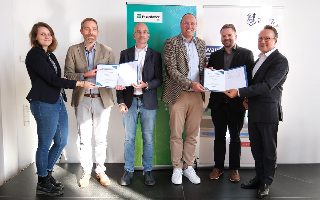
Fraunhofer IEG and the Post-Mining Research Center at Georg Agricola University of Applied Sciences have signed an agreement to research mine-water geothermal energy in Germany. They aim to develop practical guidelines, standards and training, while assessing technical, ecological, legal and economic issues around using flooded mines for heating or cooling.
Schleswig-Holstein Netz (SH Netz) has published model flexible connection agreements for standalone batteries, co-located battery projects with connection overcapacity, and large flexible electricity consumers. It also introduced criteria-based allocation of grid capacity for consumer requests above 1 MW and battery projects above 300 kW, with the next application round running from Oct. 12 to Nov. 23.
Maryland’s Public Service Commission awarded 15-year capacity credits to Flatiron Energy’s 400 MW Chalk Point battery and REV Renewables’ 40 MW Jade Meadow III, totaling 440 MW—360 MW below the first round’s 800 MW target. The four-hour projects still need construction approval; the PSC said a second solicitation must open by Jan. 1, 2027, and may include more than 40 projects emerging from PJM’s first interconnection cycle.
EUPD Research projects annual battery storage installations across Europe, including the EU, UK, Switzerland, Norway and Ukraine, will rise from 34 GWh in 2025 to 65 GWh in 2026. Utility-scale projects are expected to account for about 44 GWh, while residential installations reach roughly 15 GWh, as renewable growth, electricity costs and policy support boost demand; the report also finds competition intensifying among residential suppliers.
Google contracted to buy 3,590 megawatts of power from Constellation Energy in the largest U.S. power grid, the companies said Tuesday. New nuclear energy will account for about a quarter of the supply.
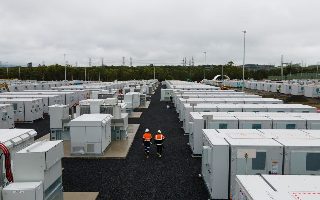
Origin is seeking federal environmental approval for the Eraring BESS North, a 500 MW battery with about 4,942 MWh of storage planned beside its Eraring power station in New South Wales. Construction is slated to begin in 2028, with operations expected in early to mid-2031; combined with existing and planned batteries at the site, the facilities would have about 1,200 MW of power capacity and 8,600 MWh of storage.
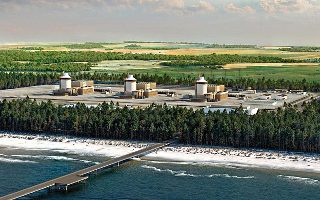
Poland’s updated nuclear programme delays the first unit at its planned 3,750 MWe Westinghouse AP1000 plant in Pomerania: commercial operation is now targeted for 2036, with full capacity expected by 2038. The Ministry of Energy also shifted the second plant’s target for its first unit to around 2040 and plans to choose its technology and strategic partner in 2027.
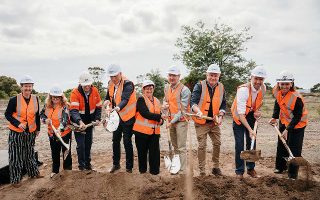
A ceremonial sod-turning marked a ramp-up in construction of the Marinus Link, a planned 345-kilometre undersea power connection between Tasmania and Victoria. The project was scaled back from two cables with 1,500 megawatts of capacity to one 750-megawatt cable; federal Energy Minister Chris Bowen and project chair Sandra Gamble say it will improve power sharing and support renewable energy and industry, while critics have raised concerns about costs and environmental impacts.
SMT Energy’s 160 MW/320 MWh Houston IV battery entered market participation on July 13, six weeks after energization—half the typical 12-week field commissioning period, according to FlexGen, which supplied its HybridOS software and led commissioning. FlexGen SVP Jason Rislov credited lab-based digital-twin testing, automated field checks and early coordination with contractor Irby; ERCOT grid qualification took a few days.
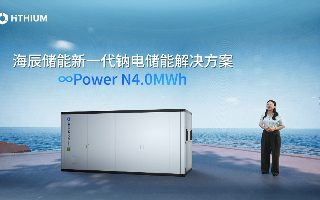
Hithium has launched a 4 MWh sodium-ion storage system and a 785 Ah cell, and senior product manager Leb Lan says the chemistry may suit projects with frequent cycling, long lifetimes or a need for more predictable material costs. Lan said mature LFP systems generally retain an upfront cost advantage, while sodium-ion still needs broader materials supply, further testing and operating data, and stronger warranties and service support to establish bankability and win large-scale orders.