Researchers explore potential of lithium-sulphur batteries electrive.com
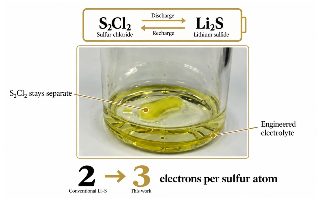
Researchers at Vanderbilt University and the University of Maryland added chlorine to lithium-sulphur battery chemistry, enabling sulphur to transfer a third electron and increasing its capacity by about 58% while raising average voltage from 2.05 to 2.54 volts. A laboratory pouch cell retained 78% of its capacity after 100 cycles; the researchers estimate the approach could reach 477 Wh/kg at cell level, though the prototype still uses substantial electrolyte and a lithium-metal anode.